3.2.14 Recycled Water Storage
This section details the Recycled Water Storage (RWS) tanks used for wet-weather storage and future reuse of Class A treated effluent. Based on the LBC OWMS O&M Manual V1.1.
Overview
After treatment, disinfection, and microfiltration, effluent is stored in a series of recycled water storage tanks before irrigation or reuse. The RWS system provides buffering capacity during wet weather when subsurface irrigation is not possible.
Tank Specifications
| Item | Detail |
|---|---|
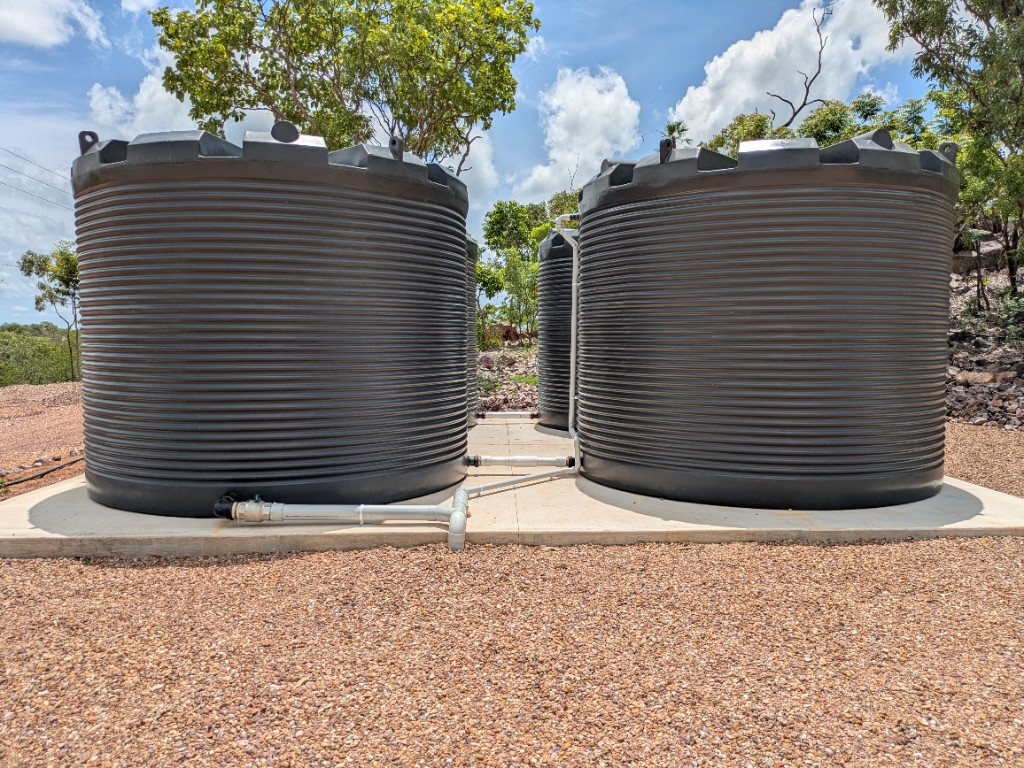
| Quantity | 4 tanks |
| Capacity | 27,000 L each |
| Total Storage | 108,000 L |
| Type | Above-ground polyethylene |
| Manufacturer | Duratanks NT |
| Siting | Four tanks on a shared concrete pad; PVC interconnects at the base |
Recycled Water Return Valve
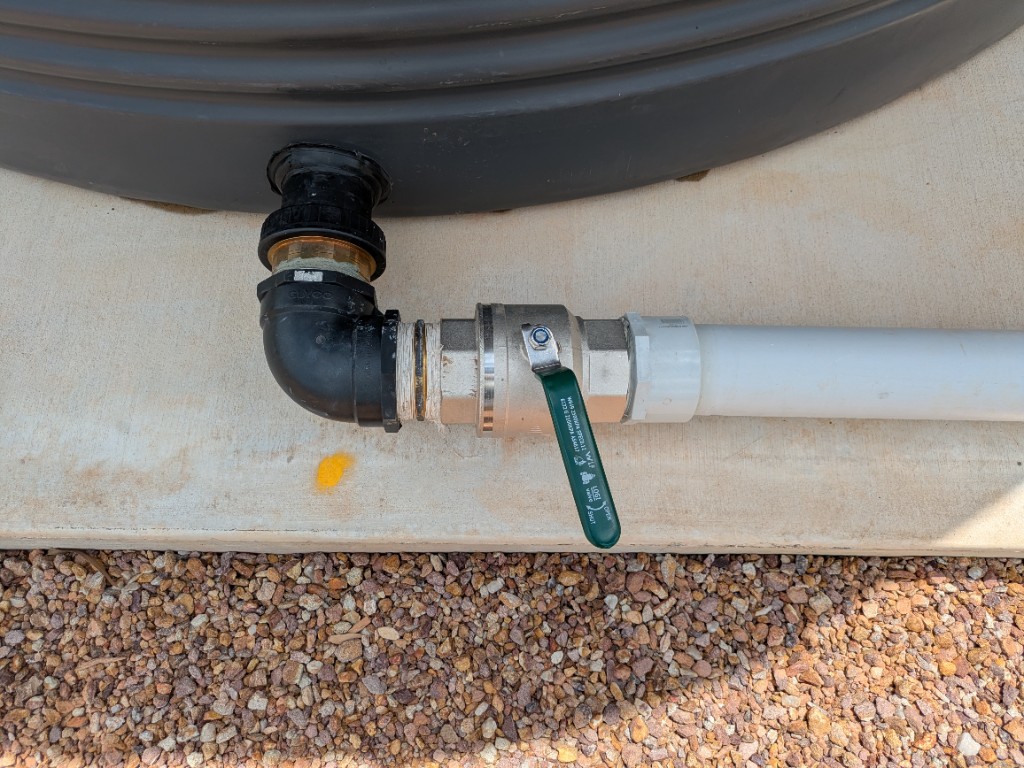
A metal ball valve on the tank-base outlet isolates stored Class A recycled water returning from the RWS tanks into the WWTP distribution system.
| Item | Detail |
|---|---|
| Location | Outlet at the base of the RWS tanks |
| Type | LOGI VALVE metal ball valve (AS 4617) |
| Function | Controls flow of recycled water from storage back into the system |
| Open | Green handle in line with the pipe |
Storage Capacity
At peak design flow of 37,800–38,800 L/day, the 108,000 L storage provides approximately 2.7–2.8 days of storage.
Distribution Logic
When the daily maximum discharge volume (default 28,600 L) is reached between midnight and 11:59 pm:
- The N/O solenoid valve closes, preventing further discharge to the LAA
- The N/C solenoid valve opens, diverting excess treated effluent to the RWS tanks
- At midnight, the daily discharge volume resets and solenoids return to normal states
Those solenoids, and the manual LAA isolation valves, are on the control-room distribution manifold. Volume is counted from the 50 mm mechanical flow meter (one pulse per 1,000 L).
Future Reuse
Class A recycled water stored in the RWS tanks is deemed safe for reuse in:
- A future community nursery propagation program
- Estate greening and landscaping initiatives
Distribution to future reuse schemes is shown on the WWTP schematic (Appendix 1). Tracked on 5. Upgrades and Outages.
Contingency — Storage Limits Reached
Description: RWS tanks at maximum volume capacity.
Causes:
- Irrigation function not available due to prolonged wet weather, combined with high accommodation occupancy
Controls:
- Engage licensed pump-out contractor McMinns Pumping Systems (0408 895 171, mcminnspumping@pbigpond.com) to remove treated effluent from RWS tanks
Cyclone Emergency
Before a cyclone or extreme weather event:
- Ensure RWS tanks are at minimum volume
- After the storm front passes, visit site to assess damage
- Engage pump-out contractor to remove treated effluent from RWS tanks if required
See 3.2.15 Cyclone Emergency for the full checklist.
Version Control
| Version | Date | Description |
|---|---|---|
| 2.0 | 2026-06-22 | Rewritten for AdvanTex WWTP per O&M Manual V1.1 |
| 2.1 | 2026-08-30 | Linked control-room manifold and 1 pulse per 1,000 L flow meter |
| 2.2 | 2026-08-30 | Photo of the four recycled water storage tanks |
| 2.3 | 2026-08-30 | Photo of the recycled water return valve at the tank base |
| 2.4 | 2026-08-31 | Linked future reuse to the upgrades register |
Next Review Date: 2026-12-22